In this article
Best 5 Alternatives to Angel Match for Founders Who Need Better Investor Access and Investors Who Want More Qualified Startup Opportunities

Angel Match is often one of the first platforms founders look at when they want to build an investor list quickly. It appeals to a simple idea: if you can access the right investor contacts, you can start outreach faster and increase your chances of raising. That can be useful at the beginning of a fundraising process. But for many founders, the challenge appears one step later. They do not just need investor names. They need a better way to reach relevant investors, manage fundraising conversations, improve investor fit, and build momentum beyond cold outreach.
On the investor side, the problem looks different. Investors are not looking for a long list of startup profiles or unfiltered pitches. They want more qualified startup opportunities, stronger context, better founder quality, and platforms that reduce noise rather than increase it. That is why Angel Match is not always enough for either side of the market. It can help with investor discovery, but it does not solve every part of fundraising execution, startup infrastructure, investor qualification, or private market intelligence.
That is where better Angel Match alternatives come in. Some platforms are better for verified founderinvestor access. Some are better for outbound fundraising workflows. Some are better for startup fundraising infrastructure and angel group management. Others are stronger at venture operations or investor research. The right choice depends on what you actually need beyond a database.
This guide breaks down five strong alternatives to Angel Match for founders and investors: The Prime Shark, OpenVC, Gust, AngelList, and Crunchbase.
Top 5 Alternatives to Angel Match
If you want the shortlist first, these are five of the strongest Angel Match alternatives worth considering:
1) The Prime Shark
Best for founders and investors looking for a verified, AIpowered ecosystem built around structured capital discovery, founderinvestor matching, and crossborder fundraising access.
2) OpenVC
Best for founders who want an investor database, fundraising CRM, and outreach workflow rather than just a static investor list.
3) Gust
Best for founders who need startup fundraising infrastructure, cap table support, incorporation tools, and angel ecosystem access, and for angel groups that want better dealflow and diligence management.
4) AngelList
Best for founders and investors who want access to a wellestablished startup investing platform with fundraising infrastructure, syndicates, SPVs, and venture ecosystem reach.
5) Crunchbase
Best for founders and investors who need private company intelligence, investor research, funding data, and startup discovery tools rather than a pure fundraising marketplace.
Angel Match Helps You Find Investors. These Platforms Solve What Comes Next.
The easiest way to understand Angel Match alternatives is to stop thinking about them as direct clones. Most of the strongest alternatives do not try to be “another Angel Match.” Instead, they solve the parts of fundraising or investing that Angel Match does not fully cover.
If Angel Match gives you investor names, what still remains?
For founders, usually one or more of these problems:
- figuring out which investors are actually worth prioritizing
- building a repeatable outreach process
- getting access to verified or higherintent investors
- preparing the company for fundraising with legal, equity, and captable infrastructure
- understanding the market better before outreach even begins
For investors, the gaps usually look like this:
- too many startup profiles with weak qualification
- limited context around startup quality and fit
- no real infrastructure for screening, diligence, or venture operations
- difficulty separating “more startup exposure” from “better startup opportunities”
That is why the best Angel Match alternative depends less on “which platform has the biggest list” and more on which fundraising or investing problem you are actually trying to fix.
The 5 Different Jobs Founders and Investors Actually Need a Platform to Do
When people say they need an alternative to Angel Match, they are often talking about one of five completely different jobs:
1) “I need better investor access, not just investor names.”
This is where a platform like The Prime Shark becomes more relevant than a pure database. It is designed around verified access, intelligent matching, and structured founderinvestor discovery.
2) “I already have investor targets. I need a better way to run outreach.”
This is where OpenVC stands out. It helps founders build investor lists, track outreach, manage conversations, and run fundraising like a process rather than a spreadsheet.
3) “I need to get my company fundraisingready.”
This is where Gust becomes a better fit. It supports incorporation, cap tables, SAFE issuance, option plans, and fundraising operations, which are often more important than investor discovery once the raise gets serious.
4) “I’m operating inside a venturebacked ecosystem, not just doing angel outreach.”
That is where AngelList comes in. It is much stronger than Angel Match when the need is SPVs, syndicates, venture funds, investor operations, or structured fundraising vehicles.
5) “I need better investor research and startup market intelligence.”
That is where Crunchbase is strongest. It is useful for researching investors, funding activity, comparable startups, market movements, and building smarter target lists before you ever send an email.
5 Better Alternatives to Angel Match Depending on What You Actually Need
1) The Prime Shark

The Prime Shark is a verified, AIpowered business investor ecosystem designed to connect founders, investors, mentors, and strategic partners in one place. Unlike a simple investordatabase platform, it focuses on structured capital discovery, intelligent matching, and crossborder growth opportunities. For founders, that means access to verified investor networks and broader support beyond cold outreach. For investors, it creates a more curated environment to discover credible startup opportunities instead of sorting through unqualified deal flow. Prime Shark is especially relevant for users who want more than investor names, they want a stronger fundraising environment built around trust, fit, and longterm growth relationships.
Best for
- Founders looking for verified investor access
- Investors seeking more qualified startup opportunities
- Businesses looking for crossborder fundraising, strategic partnerships, and ecosystem support
Why Prime Shark stands out
- AIpowered matching instead of static investorlist browsing
- Verified ecosystem for founders and investors
- Goes beyond fundraising with mentorship, networking, and strategic growth access
- Better fit for structured, hightrust founderinvestor discovery
Pros
- More curated than a standard investor database
- Founder, investor, mentor, and partner network in one ecosystem
- Strong crossborder positioning for fundraising and growth
- Better aligned with founders who want qualified access rather than mass cold outreach
Cons
- Not a public crowdfunding platform
- Public pricing is not clearly listed on the website
- Newer platform compared to AngelList or Crunchbase
Key features
- AIpowered founderinvestor matching
- Verified business and investor profiles
- Investor discovery and fundraising support
- Mentorship access
- Crossborder ecosystem and partnership support
Pricing
Prime Shark’s pricing is structured around different ecosystem products, including Capital Bridge, Business Exchange, Global Connect, and bundled combo plans.
A) Individual ecosystem plans
The Capital Bridge, Business Exchange, and Global Connect modules appear to follow the same pricing structure:
Free Trial – ₹0 for 15 days
Silver – ₹51.97K / quarter
Gold – ₹77.95K / half year
Premium – ₹1.17L / year
B) Combo plans
Prime Shark also offers bundled plans such as Capital Bridge + Global Connect and Business Exchange + Global Connect, promoted with a 10% combo discount.
One visible combo pricing structure is:
Silver – ₹93.54K / quarter
Gold – ₹1.40L / half year
Premium – ₹2.10L / year
2) OpenVC
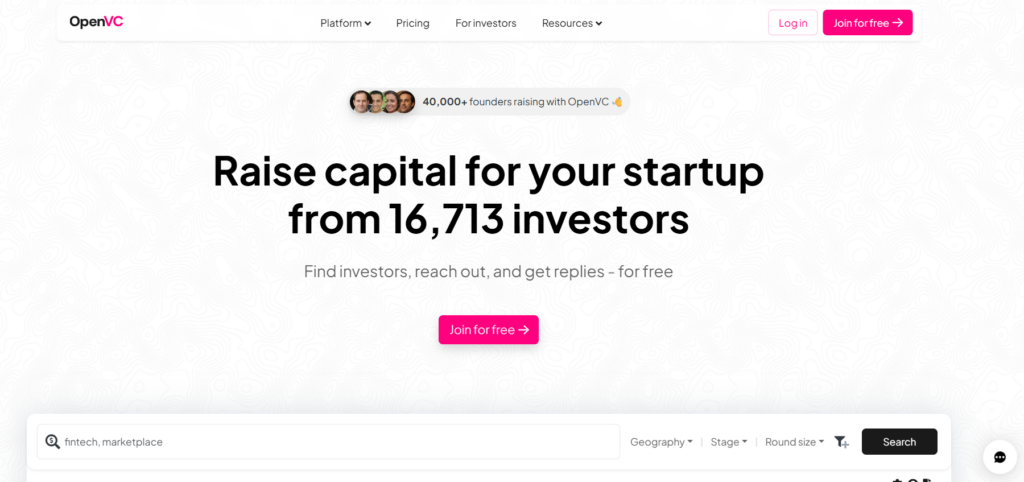
OpenVC is one of the closest alternatives to Angel Match if your main problem is not “where do I find investors?” but “how do I run fundraising properly once I have them?” It is less of a pure investor list and more of a fundraising operating system for founders. OpenVC combines investor discovery with a CRM, deck tracking, outreach tools, investor filters, introfinding capabilities, and fundraising education. Instead of simply giving founders names, it helps them build a repeatable fundraising process. For founders who are actively doing outbound fundraising and want more control over investor targeting, OpenVC is often a more useful tool than a contactled database alone.
Best for
- Founders doing targeted investor outreach
- Startups that want a fundraising CRM plus investor database
- Teams that want more control over the fundraising process
Why OpenVC stands out
- Built around fundraising execution, not just investor discovery
- Helps founders shortlist investors and manage outreach in one workflow
- Includes CRM, deck tracking, and investor targeting tools
- Offers a strong free tier for earlystage founders
Pros
- Better fundraising workflow than a basic investordatabase platform
- Useful for building investor lists and managing outreach
- Free plan available for earlystage teams
- Strong fit for founders who prefer proactive fundraising
Cons
- Not a curated founderinvestor marketplace
- More foundertool focused than investormarketplace focused
- Less useful if you want a verified ecosystem or investorside screening layer
Key features
- Investor database
- Fundraising CRM
- Deck tracking
- Investor shortlist building
- Outreach workflow support
- Intro finder and fundraising education resources
Pricing
- Free plan available with most core features
- Premium: $99/month or $299/year
3) Gust
Gust is a very different kind of Angel Match alternative because it is not primarily about investor outreach. It is stronger as a startup fundraising infrastructure and angel group management platform. Gust helps founders incorporate, manage cap tables, issue founder stock, create SAFEs and convertible notes, model ownership, and prepare the company for fundraising. On the investor side, Gust has long been used by angel groups and earlystage investment organizations to manage deal intake, screening, due diligence, and collaboration. If Angel Match feels too narrow because it stops at investor discovery, Gust is one of the better alternatives for founders who need more of the “companybuilding and fundraising operations” layer.
Best for
- Founders who want startup infrastructure plus fundraising support
- Angel groups and investor organizations managing deal flow and diligence
- Startups preparing for more formal fundraising workflows
Why Gust stands out
- Strong infrastructure for startup formation, equity, and fundraising workflows
- Useful for both founders and investor groups
- Goes beyond investor access with cap table, SAFE, and option management tools
- Longstanding presence in the angel and earlystage investing ecosystem
Pros
- More operational depth than a simple investor database
- Useful for both startup operations and fundraising readiness
- Strong fit for angel groups and organized investor communities
- Combines equity, legal, and fundraising workflows in one place
Cons
- Not primarily a founderinvestor matching marketplace
- More infrastructurefocused than outreachfocused
- Public pricing is centered on startup operations rather than investor access
Key features
- Delaware incorporation and postincorporation setup
- Cap table and equity management
- SAFE and convertible note workflows
- Option plan and 409A valuation support
- Angel group deal flow, screening, diligence, and collaboration tools
Pricing
Gust’s startup plans are publicly listed as:
- Start: $450/year
- Accelerate: $1,250/year
- Raise: $3,500/year
These plans are mainly tied to startup formation, legal, cap table, and fundraising operations rather than a pure investordirectory product.
4) AngelList
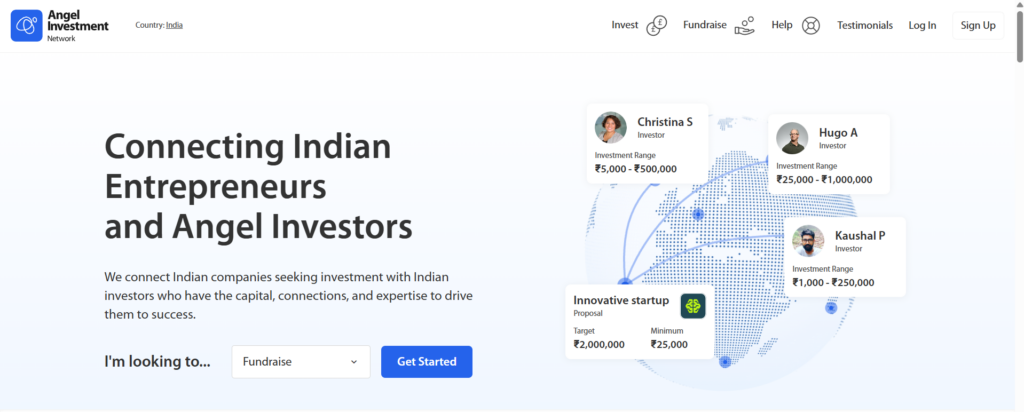
AngelList is one of the most recognizable names in startup investing, but it should not be thought of only as a founderinvestor discovery platform. Today, it functions much more as venture infrastructure than a simple angel network. For founders, AngelList can support startup incorporation, cap table management, fundraising workflows, and venturebacked fundraising structures. For investors, it is significantly stronger than Angel Match when it comes to SPVs, syndicates, venture funds, and privatemarket fund operations. That means AngelList is especially relevant when the fundraising or investing process is already operating inside a more formal venture ecosystem.
Best for
- Founders who want access to venturebacked fundraising infrastructure
- Investors, syndicate leads, and fund managers running SPVs, funds, or privatemarket operations
- Startups that want fundraising and equity workflows tied into a larger venture ecosystem
Why AngelList stands out
- Strong brand and deep network in the startup investing ecosystem
- More than a founderinvestor directory supports SPVs, funds, RUVs, and startup operations
- Useful for both startups and investors operating in venturebacked environments
- Stronger infrastructure layer than most fundraising marketplaces
Pros
- Large startup and investor network
- Strong for structured venture fundraising and investment operations
- Useful for SPVs, syndicates, and fund administration
- Better fit than Angel Match for users who need platformlevel venture infrastructure
Cons
- Less straightforward than simple investor discovery tools
- Not every founder needs fund admin or SPVrelated functionality
- Pricing varies by product rather than offering one simple founder subscription
Key features
- Startup incorporation and equity setup
- SPVs and venture fund administration
- Investor management and LP workflows
- Cap table and startup equity tools
- Startup fundraising infrastructure for venturebacked companies
Pricing
AngelList pricing depends on the product used:
- Startup incorporation: around $500 onetime
- SPVs: typically $8,000 setup fee plus a $2,000 bluesky fee
- Followon SPVs: reduced pricing may apply in some cases
Because AngelList serves multiple user types, pricing is productspecific rather than one flat platform fee.
5) Crunchbase
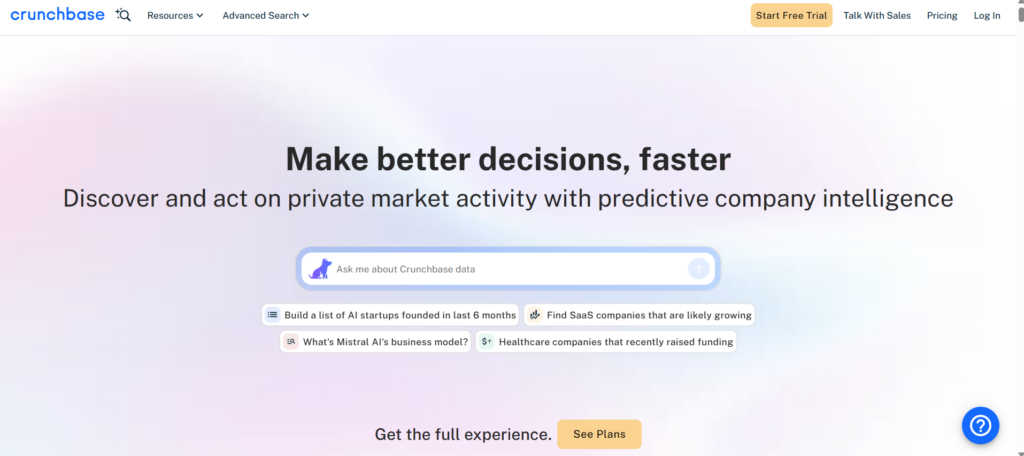
Crunchbase is not a fundraising marketplace in the same way as Angel Match, Prime Shark, or AngelList. It is better understood as a private company intelligence platform. That difference matters. If Angel Match helps founders find investor contacts, Crunchbase helps them build a smarter map of the market, which investors are active, which companies raised recently, who backed whom, how competitors are funded, what sectors are heating up, and where opportunities are moving. For investors, Crunchbase is useful for startup discovery, market research, funding analysis, and company tracking. In other words, it is less about direct founderinvestor matching and more about research, prioritization, and decision support.
Best for
- Founders researching investors, startups, and funding activity
- Investors tracking private companies, sectors, and market movements
- Teams that need company intelligence, investor research, and exportable data
Why Crunchbase stands out
- Massive privatecompany and investor database
- Useful for investor research, market mapping, and startup discovery
- Stronger than Angel Match for company intelligence and market tracking
- Business plan adds AI insights, predictions, CRM integrations, and larger export limits
Pros
- Strong brand recognition in startup and VC research
- Better fit than Angel Match for company intelligence and funding research
- Useful for founders building investor target lists and market maps
- Helpful for investors who want broad startup discovery and trend visibility
Cons
- Not a direct founderinvestor matching platform
- Less relationshipdriven than ecosystem platforms or investor marketplaces
- Best value comes when you actively use the data for research, prospecting, or analysis
Key features
- Search millions of private companies and investors
- Funding, firmographic, and financial data
- Saved searches, lists, alerts, and tracking
- Export functionality
- AI insights, predictions, and CRM integrations on higher plans
Pricing
Crunchbase’s public pricing is structured as:
- Pro: $49/month billed annually (introductory firstyear annual offer for new users) or $99/month billed monthly
- Business: starts at $199/month billed annually
- API: custom pricing
Angel Match Alternatives Compared at a Glance
| Platform | Best For | Strongest Use Case | Founder Fit | Investor Fit | Pricing Snapshot |
| The Prime Shark | Founders and investors who want a verified, AIpowered capital ecosystem | Structured founderinvestor matching, verified investor access, crossborder fundraising visibility | Excellent for founders who want better investor access with more trust and structure | Strong for investors who want more qualified startup opportunities | Individual plans start with 15 day free trial, then Silver ₹51.97K/quarter, Gold ₹77.95K/half year, Premium ₹1.17L/year; combo plans from ₹93.54K/quarter |
| OpenVC | Founders who want investor outreach workflow and fundraising CRM support | Investor database + fundraising execution + outreach management | Excellent for founders running proactive investor outreach | Limited investorside depth compared to investorfirst platforms | Free tier + Premium at $99/mo or $299/yr |
| Gust | Founders needing startup infrastructure and angel groups managing deal flow | Startup formation, cap table, fundraising workflows, angel group management | Strong for founders preparing for formal fundraising and equity management | Strong for angel groups and investor organizations | Start: $450/yr; Accelerate: $1,250/yr; Raise: $3,500/yr |
| AngelList | Founders, investors, syndicate leads, and fund managers in venturebacked environments | SPVs, startup fundraising infrastructure, venture fund administration | Strong for founders using venture fundraising structures | Very strong for investors, SPV leads, and fund managers | Incorporation from ~$500; SPVs from ~$8k + fees |
| Crunchbase | Founders and investors who need private market intelligence and investor/company research | Startup research, investor discovery, funding data, market intelligence | Strong for founders building investor target lists and market maps | Strong for investors researching startups, sectors, and funding trends | Pro from $49/mo annual intro or $99/mo monthly; Business from $199/mo |
If Angel Match Feels Too Basic, Here’s the Better Direction to Take
A good way to choose an Angel Match alternative is to ask what part of the process feels broken right now.
If your problem is finding verified investors
Go with The Prime Shark.
It is the strongest fit when you want investor access with more trust, more structure, and better founderinvestor alignment.
If your problem is managing outreach and followups
Go with OpenVC.
It is built for founders who need a real fundraising workflow instead of a contact list and a spreadsheet.
If your problem is startup fundraising setup and legal/equity workflows
Go with Gust.
It is much more useful than Angel Match when the real issue is fundraising readiness rather than investor discovery.
If your problem is venturebacked fundraising structures and SPVs
Go with AngelList.
It is the better fit when you are operating in a formal venture ecosystem and need platformlevel investment infrastructure.
If your problem is researching investors and mapping the market
Go with Crunchbase.
It is ideal when the challenge is investor targeting, market intelligence, and startup/funding research rather than direct platformbased matching.
Which Angel Match Alternative Makes the Most Sense for Your Actual Fundraising Problem?
Not every platform in this list is trying to do the exact same job as Angel Match. Some are closer substitutes for investor discovery and outreach. Others solve a much bigger problem by adding fundraising infrastructure, verification, venture workflows, or market intelligence.
If you want a stronger, more structured alternative to Angel Match, start with The Prime Shark
The Prime Shark is the strongest option in this list if Angel Match feels too limited because it stops at investor discovery. Instead of simply helping founders find investor names, Prime Shark is built around verified founderinvestor access, AIpowered matching, and a broader fundraising ecosystem. For investors, it also offers a more qualified startup environment rather than a founderled outreach database. In other words, it is not just a replacement for Angel Match, it is a stronger upgrade for users who care about access quality, trust, and smarter matching.
If you want something closest to Angel Match in daytoday use, OpenVC is the nearest fit
OpenVC is one of the closest alternatives to Angel Match because it still focuses heavily on finding investors and managing founder outreach. The difference is that OpenVC goes further into execution. Instead of stopping at investor discovery, it adds CRM workflows, deck tracking, investor shortlisting, and fundraising process management, which makes it a stronger option for founders who want to run outbound fundraising more systematically.
Crunchbase is a strong alternative if your real need is investor research, not investor matching
Crunchbase overlaps with Angel Match when your main use case is building investor lists, researching who funds what, studying recent funding activity, and mapping the market. It is not built as a founderinvestor matching platform, but it can absolutely replace Angel Match for founders and investors who care more about intelligence, targeting, and market visibility than direct platformbased interactions.
Gust solves a different problem: fundraising infrastructure
Gust is not really a close substitute for Angel Match. It becomes relevant when the problem is no longer investor discovery, but startup readiness, cap tables, incorporation, SAFE issuance, option plans, and angel group workflows. If Angel Match feels too narrow because it only helps at the top of the funnel, Gust is a stronger fit for the operational side of fundraising.
AngelList is the biggerplatform option for venturebacked fundraising and investing
AngelList also goes well beyond Angel Match. It is more useful when fundraising or investing is happening inside a venturebacked structure such as SPVs, syndicates, startup incorporation, or fund administration. If Angel Match is the tool you use to find investor contacts, AngelList is the tool you look at when the fundraising or investment process becomes much more structured and venturedriven.
My Shortlist by Use Case
If you want the fastest possible answer, here is the practical shortlist:
- Best for founders seeking better investor access and investors looking for more qualified startup opportunities: The Prime Shark
- Best for founderled outbound fundraising execution: OpenVC
- Best for startup fundraising infrastructure: Gust
- Best for venturebacked investing workflows and SPVs: AngelList
- Best for investor research and private market data: Crunchbase
FAQs
1) What is the best alternative to Angel Match for founders?
If your goal is better investor access rather than just a bigger investor list, The Prime Shark is one of the strongest alternatives. If your goal is to manage investor outreach more efficiently, OpenVC is also a strong option.
2) What is the best Angel Match alternative for investors?
That depends on what you want. Investors looking for more qualified startup opportunities may prefer The Prime Shark, while investors who need venture infrastructure or SPV workflows may lean toward AngelList.
3) Is OpenVC better than Angel Match?
OpenVC can be a better fit if your problem is not finding investors, but running the fundraising process, including targeting, outreach, followups, CRM, and deck tracking.
4) Is Gust an alternative to Angel Match?
Yes, but it solves a different problem. Gust is less about investorlist discovery and more about startup fundraising infrastructure, equity management, angel group workflows, and fundraising readiness.
5) Is AngelList a good alternative to Angel Match?
Yes, especially if you are operating in a venturebacked environment and need more than investor names. AngelList is stronger for SPVs, startup fundraising infrastructure, investor operations, and venture fund workflows.
6) Is Crunchbase an Angel Match replacement?
Crunchbase can replace Angel Match for teams whose main goal is investor research, startup intelligence, funding analysis, and market mapping. It is less of a direct founderinvestor marketplace and more of a privatemarket intelligence platform.
7) Which Angel Match alternative is best for startup investor research?
If your main goal is to research investors, companies, funding rounds, and privatemarket activity, Crunchbase is one of the strongest alternatives in this list.
8) Are these Angel Match alternatives free to use?
Some have free layers and some do not. OpenVC offers a free tier. Crunchbase has paid plans for deeper access. Gust uses annual pricing for startup formation and fundraising tools. AngelList pricing depends on the product used, while Prime Shark pricing should be checked directly with the platform.